See where forklifts and people on foot come too close
Forklifts and people on foot share aisles, yards and loading bays. A near miss leaves no injury, and often no report, so the log can look calm while the risk is still there.
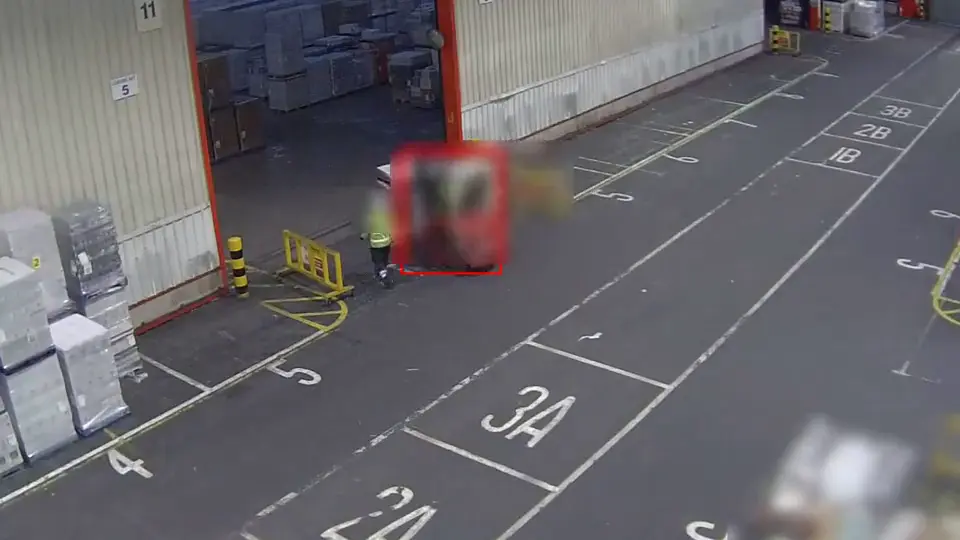
RoboK SiteLens uses the cameras you already have, or our own 4G camera, to flag forklift near misses and people in vehicle areas. Each event arrives as a short clip with its time, place and type, and your team decides what to change.
Site cameras or in-cab sensors?
They do different jobs, and many sites use both. In-cab and wearable systems (proximity tags, on-vehicle cameras or radar) warn the driver or the person on foot in the moment. A fixed camera on the area shows what keeps happening there over weeks: which crossing, which shift, which manoeuvre. That is what lets you change the layout, the route or the rule.
RoboK SiteLens is the second kind; it does not sound an alarm in the cab. Neither kind replaces keeping people and forklifts apart in the first place.
Compare cameras, tags and on-vehicle systems
What it detects
Forklift near misses
Forklifts and other vehicles coming too close to people on foot.
People in vehicle routes
People in vehicle-only areas and outside marked walkways.
Restricted zones
Entries to restricted or exclusion zones your site defines.
PPE
Hi-vis, hard hats, gloves or harnesses, where your site requires them.
Loading bays and vehicle routes
Loading bay and dock behaviour, and vehicles driving against a one-way flow or off the marked route.
Several detections, one camera
Set per zone, with no extra licence per detection: one annual subscription per camera view covers every use case and every user. Speed monitoring is also available.
Who we work with
"Operatives on the next shift are more alert to keeping themselves and each other safe. I am impressed by how much useful detail we have gained."
David Brown, CEO, The Bristol Port Company
The Bristol Port Company reported more than 90% fewer potential safety breaches within three months of going live. With the Port of Dover, our work won Safer Logistics at the SHE Awards 2025.
How the trial works
One camera, one area, two weeks
You choose the aisle, crossing or loading bay you worry about most. The trial is free.
Our camera or yours
Our camera runs on its own 4G and needs mains power only, with no access to your network. Or the trial can run on one of your cameras, once your IT team agrees access.
First events in one to two weeks
Typically one to two weeks from camera access to the first events.
A written report and a review call
Then you decide. If you don't carry on, you keep the report and there is nothing to pay.
Your risk assessment sets the controls. The cameras check them.
Your risk assessment says where forklifts and people should be kept apart, and how. What it can't show on paper is whether those controls hold on every shift. Clips and trends show where a control is working and where it isn't, so the next review starts from evidence.
- Workplace transport risk assessment: a worked example and free template
- Pedestrian segregation: how to check it actually works
- Forklift accidents: common causes and how to prevent them
Common questions
Does it work on our existing CCTV?
Usually, yes. RoboK SiteLens works with standard IP camera streams (RTSP; ONVIF supported). We check each camera view at setup against the detections you've chosen and tell you where a view won't work well. Where a zone has no usable camera, we can supply a 4G camera.
What do drivers and staff see?
Nothing changes in the cab or on the floor: there is no device on the truck and no alarm. Each event goes to the named users at your site as a short clip. Faces can be blurred, and areas you don't need to monitor masked, on request. As with any CCTV, tell your team what the camera is for before it starts.
Where is the footage kept, and for how long?
Footage is processed and stored securely; where it is held is set out in your contract. Footage is kept for 30 days as standard and event clips for the subscription term; both can be varied by contract. Access is limited to named user accounts, and system access is logged.
How long does setup take?
On our 4G camera, it needs mains power and nothing else. On your own cameras, typically one to two weeks from camera access to the first events.
Free two-week Safety Mapping trial on one camera. Get started or book a demo.
Used at sites including The Bristol Port Company, Port of Dover, Peel Ports, PD Ports, Port of Tyne, DPD Ireland, PPG and Transport for Wales.