Active and Reactive Monitoring: What HSG65 Actually Asks For
The distinction is older than most of the people using it. HSG65 has carried it since the 1990s, and the current edition keeps it at the heart of the Check stage of Plan, Do, Check, Act. It has lasted because it is simple and because it maps onto a real difference in how information reaches a safety manager.
What is active monitoring?
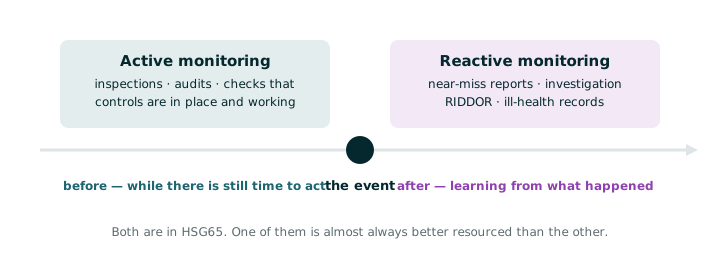
Active monitoring is checking, on purpose and on a schedule, that the things you decided to do are being done, and that they are working. The HSE's list is practical: workplace inspections, audits of the management system, checks that procedures are followed, observation of how work is actually carried out, and health surveillance where exposure makes it necessary.
The defining feature is timing. Active monitoring happens before harm, so what it finds can still be acted on. A barrier that an inspection finds unlatched is a barrier someone can latch, which is the whole case for checking barriers over time.
The defining difficulty is also timing. Nothing has gone wrong, so nothing is demanding that the check takes place. Active monitoring runs on discipline, not on events, and discipline competes with every other call on a manager's week.
Active monitoring tells you about the controls while there is still time to do something about them.
What is reactive monitoring?
Reactive monitoring is learning from events that have already happened: accidents and incidents, near misses, dangerous occurrences, cases of ill health, complaints, and the statutory reporting that follows some of them under RIDDOR. It asks what happened, why, and what should change.
Its great strength is that it is self-starting. An incident produces a report because it has to. An investigation is opened because something visibly needs explaining. Nobody has to remember to do reactive monitoring; the event does the remembering, provided someone reports it.
Its limit is the one HSG65 is quietly pointing at by naming both: everything it tells you is about a state that already existed. By the time a near miss is written up, the conditions that produced it have been in place for a while, and may have moved on.
Why does the balance drift towards reactive?
Not through neglect. Three ordinary pressures push the same way.
Events are legible. An incident has a date, a person, a form, sometimes a legal duty. An inspection that found nothing wrong has none of those, and is the first thing displaced when the week fills up. Reactive monitoring is protected by its own paperwork.
Reactive data is easier to count. Injury rates, days lost, RIDDORs per year: these roll up into a board slide. Active monitoring produces findings, not totals, and findings are harder to trend. So reporting gravitates to the reactive numbers, and what gets reported gets resourced.
Checking is expensive. A real inspection takes someone away from everything else for an hour, and a site has more shifts and more corners than any inspection schedule covers. So active monitoring is sampled, honestly and sensibly, and the sample stands in for the whole.
None of this is a failing. It is what happens when a scarce resource meets an unforced task. The value of HSG65 naming both kinds is that it makes the drift visible, so an organisation can decide about it rather than arrive at it.
An inspection that found nothing wrong has no date, no form and no legal duty. It is the first thing displaced when the week fills up.
How does this relate to leading and lagging indicators?
Closely, and the vocabulary overlaps. Active monitoring produces leading information: it describes the state of controls now. Reactive monitoring produces lagging information: it describes outcomes that have already occurred. HSE's guidance on process safety indicators, HSG254, pairs the two deliberately, a leading measure of whether a control is operating alongside a lagging measure of whether it failed.
The pairing is the useful part. A near-miss count on its own can rise because conditions got worse or because people started reporting more. Set it beside an active measure, say, the share of scheduled inspections completed and the share of controls found working, and the number starts to mean something.
What would a better balance look like?
Not less reactive monitoring. Investigation is where the deepest learning happens, and a culture that reports near misses freely is worth protecting. The aim is to bring active monitoring up to the same standing, which in practice means three things.
Give it a number. If inspections completed and controls found working are reported next to injury rates, they stop being invisible.
Make the finding, not the visit, the unit. An inspection that records "no issues" has produced very little. One that records which controls were checked, and in what state, has produced something the next inspection can be compared against.
Widen the sample where you can. The honest limit of active monitoring has always been that one person cannot see a whole site on every shift. Anything that extends how much of the site is actually being checked, rather than assumed, moves the balance.
The question worth asking on Monday
Take the last month. How many hours went into responding to events, and how many into scheduled checks that controls were working? Nobody needs the ratio to be exact. The point is to see it, because the balance between the two is a decision, and most organisations have never made it consciously.
HSG65 has been asking for both for thirty years. The profession has always done the second one well. The interesting work now is in the first.
Common questions
What is the difference between active and reactive monitoring in health and safety?
Active monitoring checks that risk controls are in place and working before anything goes wrong: inspections, audits, observation of work, checks on procedures, health surveillance. Reactive monitoring learns from events that have already happened: accidents, incidents, near misses, ill health, and statutory reports under RIDDOR. HSE's HSG65 guidance asks for both as part of the Check stage of Plan, Do, Check, Act.
Is active monitoring the same as a leading indicator?
Broadly, yes. Active monitoring produces leading information, which describes the current state of controls. Reactive monitoring produces lagging information, which describes outcomes. HSE's HSG254 recommends pairing a leading and a lagging indicator for each critical control, so that a change in one can be read against the other.
Is a near-miss report active or reactive monitoring?
Reactive. A near miss is an event that has already happened, even though no harm resulted. It is valuable precisely because it arrives before an injury, but it still describes conditions that already existed. The active equivalent would be the inspection or observation that found the hazard before the near miss occurred.
What does HSG65 say about monitoring?
HSG65, Managing for health and safety, places monitoring in the Check stage of its Plan, Do, Check, Act model. It asks organisations to measure performance using both active monitoring, before things go wrong, and reactive monitoring, after they do, and to investigate the causes of accidents, incidents and near misses. ISO 45001 clause 9.1 makes a similar requirement for monitoring, measurement, analysis and performance evaluation.
How much active monitoring is enough?
There is no fixed ratio in the guidance. A practical test is whether active monitoring produces findings that change anything. If inspections consistently record "no issues" while reactive reports keep arriving, the active side is probably sampling too narrowly or recording too little. The aim is a schedule the organisation actually keeps, that checks the controls that matter most, and that records their state rather than just the visit.
References
- Health and Safety Executive (2013). Managing for health and safety (HSG65), 3rd edition. HSE Books.
- Health and Safety Executive (2006). Developing process safety indicators: A step-by-step guide for chemical and major hazard industries (HSG254). HSE Books.
- Health and Safety Executive (2001). A guide to measuring health and safety performance. HSE.
- The Reporting of Injuries, Diseases and Dangerous Occurrences Regulations 2013 (RIDDOR), SI 2013/1471.
- ISO 45001:2018. Occupational health and safety management systems — Requirements with guidance for use, clause 9.1. International Organization for Standardization.
- Hopkins, A. (2009). Thinking about process safety indicators. Safety Science, 47(4), 460–465.
This piece starts from the ideas set out in How We Think About Safety.
Wondering what a camera would see at your gate? Request a Safety Mapping — one camera, two weeks, at no cost.