The Procedure and the Practice Are Never the Same Document
Find the gap and you have found where your risk actually sits. Find it after an incident and you have found it too late.
What is work-as-imagined?
Erik Hollnagel gave the distinction its name. Work-as-imagined is the job as pictured by the people who design it, write the procedure, set the time allowance and sign the risk assessment. Work-as-done is what happens on the shift.
Steven Shorrock extended it usefully, pointing out that there are at least four accounts of any job in circulation at once.
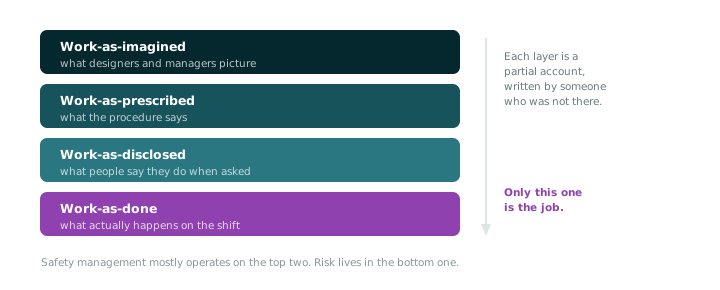
Work-as-disclosed deserves particular attention. It is what people tell you when you ask — in an audit, a survey, an investigation. It is not usually dishonest. It is a description shaped by who is asking, what seems relevant, and what is safe to say. It drifts toward work-as-prescribed without anybody intending it to.
Much of safety management operates on the top two layers. Most risk lives in the bottom one.
Why the gap always exists
It is tempting to treat divergence as a discipline problem. It is better understood as arithmetic.
A procedure is written once, in advance, for a general case, much as a control is chosen once. The work happens many times, in specific conditions, each with its own variations: the pallet is stacked differently, the delivery is late, the usual route is blocked, someone is covering a role they do not normally do.
Hollnagel's ETTO principle — efficiency–thoroughness trade-off — describes what people do about that. Everyone, constantly, trades thoroughness against efficiency, because doing everything thoroughly all of the time is not possible. Mostly these trades are correct, which is why the work succeeds nearly every time.
The adaptations that keep production running on a normal day are the same adaptations present on the day something goes wrong. You cannot encourage one and prohibit the other.
This is Hollnagel's Safety-II point in practice. Studying only the rare failures means studying the same behaviour that produced thousands of successes, and drawing a conclusion about it only when the outcome was bad.
So is the gap a problem or not?
Both, and the distinction is worth getting right.
A gap that absorbs variation is the system working. An experienced operator adjusting to conditions a document could not foresee is the reason the job gets done at all. Remove that and output stops. Anyone who has watched a work-to-rule knows how thoroughly.
A gap that has quietly become the standard is drift. Rasmussen described the mechanism: under steady efficiency pressure, practice migrates toward the edge of the safe envelope in small, locally sensible steps. Diane Vaughan called the end state the normalisation of deviance.
The difference is not visible in a single observation. One person taking a shortcut once is adaptation. Everyone taking it, always, and new starters learning it as the method, is drift.
Which means the gap is only interpretable in aggregate and over time — which is precisely how it is almost never looked at.
What the gap tells you
Treated as information rather than misconduct, a divergence is one of the most useful things a site can know.
A procedure that is never followed as written is a design fault, not a compliance fault. If nobody does it the documented way, the document is wrong, or the time allowed is wrong, or the equipment does not support it. That is fixable, and it is fixable before anything happens.
The adaptation usually points at the real constraint. People do not add steps for fun. A workaround is evidence about pressure, layout, tooling or staffing — and it is more reliable evidence than a survey, because it is revealed rather than reported.
The gap predicts where a barrier will fail. A barrier that depends on a procedural step nobody performs is not a barrier. It is a line on a diagram.
How to see it without waiting for an incident
Ask about the job, not about compliance. "Talk me through how this actually gets done, including the bits that are not in the document" gets a different answer from "do you follow the procedure?" The first invites expertise. The second invites work-as-disclosed.
Go and watch, and resist correcting. The moment an observation becomes an audit, what you are watching turns into work-as-prescribed. Several methods formalise this — learning teams, human and organisational performance — and they share one rule: separate learning from judgement, or you get neither.
Look for patterns, not instances. A single adaptation is a data point. The same adaptation across a shift, a team or a month is a statement about the design of the work.
Be clear about what you can actually see. Most organisations understand work-as-done through occasional observation by people whose presence changes it. That is a real constraint, and naming it is more useful than pretending the audit sample is the picture. Anything that shows how the work runs when nobody is standing there with a clipboard is answering a question the clipboard cannot.
The reframe
The useful mental move is to stop treating the procedure as the truth and the practice as the deviation.
The practice is the truth. The procedure is a model of it, in the same way a bowtie is a model of the barriers — a useful, necessary, usually expected model, written in advance by people who could not know everything.
When the model and reality disagree, something has been learned. The only wasted version is the one where nobody finds out until an investigation.
Common questions
What is work-as-imagined versus work-as-done?
Work-as-imagined is the job as pictured by those who design it, write procedures and allocate time. Work-as-done is what actually happens on the shift. The terms come from Erik Hollnagel's work on resilience engineering and Safety-II.
Is the gap between procedure and practice a sign of poor discipline?
Usually not. Procedures are written once, in advance, for a general case, while the work happens many times under varying conditions. The gap is mostly adaptation — people closing the distance between the document and the situation. It becomes a problem when it stops being a response to conditions and becomes the unexamined standard.
What is the ETTO principle?
Hollnagel's efficiency–thoroughness trade-off: people constantly trade thoroughness against efficiency because being completely thorough all the time is impossible. These trades are usually correct, which is why work succeeds the overwhelming majority of the time.
What is work-as-disclosed?
A term from Steven Shorrock's extension of the model: what people say they do when asked, in an audit, survey or interview. It is rarely dishonest, but it is shaped by who is asking and what feels safe to say, and it tends to drift toward the written procedure.
How can you find out how work is really done?
Ask about the job rather than about compliance, observe without correcting, and look for repeated patterns rather than single instances. The main constraint is that observation by someone with authority tends to turn work-as-done back into work-as-prescribed while they are watching.
References
- Hollnagel, E. (2014) Safety-I and Safety-II: The Past and Future of Safety Management
- Hollnagel, E. (2017) Safety-II in Practice: Developing the Resilience Potentials
- Hollnagel, E. (2009) The ETTO Principle: Efficiency-Thoroughness Trade-Off
- Shorrock, S. (2016) "The Varieties of Human Work", Humanistic Systems / EUROCONTROL HindSight
- Rasmussen, J. (1997) "Risk management in a dynamic society: a modelling problem", Safety Science 27(2/3)
- Vaughan, D. (1996) The Challenger Launch Decision — normalisation of deviance
- Dekker, S. (2014) The Field Guide to Understanding 'Human Error'
- Conklin, T. (2019) The 5 Principles of Human Performance
Published 18 November 2026 · Last updated 18 November 2026
This piece starts from the ideas set out in How We Think About Safety.
Wondering what a camera would see at your gate? Request a Safety Mapping — one camera, two weeks, at no cost.