Dark Yards: The Four Weeks After the Clocks Change
Every autumn the same thing happens in yards, on quaysides and across distribution centres. The work is the same. The traffic plan is the same. The people are the same. The only thing that moves is sunrise and sunset, and it moves fast: roughly an hour and a half of daylight lost between the end of October and the end of November. Shift patterns do not move with it.
Why do the four weeks after the clocks change matter?
Because of where the shift changes fall. A yard that starts at 06:00 was working in daylight by the middle of the shift in September. Now the first hour is dark, the handover is dark, and the people arriving are walking from a car park to a welfare block across a yard that vehicles are already using. At the other end, the afternoon shift that used to finish in daylight now finishes after sunset.
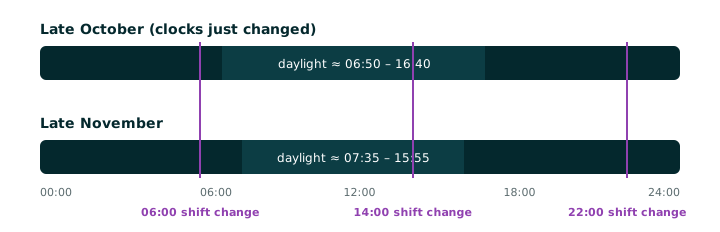
Shift change is already the busiest pedestrian moment of the day. Putting it in the dark adds three things at once: drivers see less, walkers see less, and both are more likely to be looking at a phone, a clipboard or the ground.
What does the guidance actually ask for?
Nothing exotic. The HSE's workplace transport guidance, HSG136, has been consistent for years, and its themes are the ones that matter most in low light.
Lighting adequate for the task. The Workplace (Health, Safety and Welfare) Regulations 1992 require suitable and sufficient lighting, and HSE's Lighting at work (HSG38) explains what that means in practice: enough light to see hazards, no deep shadows at crossings and reversing areas, and no glare that blinds a driver turning into a bay. A yard lit for security is not necessarily lit for pedestrians.
Segregation. The single most effective workplace transport control is keeping people and vehicles apart: separate routes, physical barriers, marked crossings. HSG136 is explicit that segregation should be designed in rather than left to behaviour. In the dark, the markings that guide behaviour are harder to see, so the physical separation is doing more of the work.
Visibility. High-visibility clothing (to BS EN ISO 20471) for anyone on foot in vehicle areas, clean and working vehicle lights, and reversing aids where reversing cannot be designed out. HSE's guidance treats reversing as a particular hazard, and it is worse in the dark.
Procedures that survive the conditions. A traffic management plan written for a daylight yard may rely on a banksman's hand signals, a painted walkway, or a driver's line of sight, all of which degrade after dark and in rain.
The traffic plan was written for the yard as it looked in June. The yard in November is a different place with the same drawing.
What usually happens instead?
Not neglect. Three ordinary things.
The lighting was checked once. Usually when it was installed, often in summer. Lamps fail, trees grow, a new container stack casts a shadow across the crossing, and nobody is on the yard at 06:30 with the lighting in mind.
Behaviour adapts without anyone deciding it should. People take the short route across the yard because the marked walkway is dark and wet. Drivers skip the reversing check because it is cold and the bay has always been clear. Each adaptation is sensible in the moment. This is the drift Rasmussen described: small, local, reasonable, and invisible until something happens; the gap between the procedure and the practice.
The check happens in daylight. Safety walks, inspections and audits, the active monitoring HSG65 asks for, are mostly done between 09:00 and 16:00, by people who work days. The hours that changed are precisely the ones nobody inspects.
Five things to check this week
- Walk the yard at a dark shift change. Not at 10:00. Stand where the pedestrians arrive and watch where they actually go.
- Look at the lit yard from the driver's seat. Where are the shadows? Where does the glare fall? Is the crossing visible from the approach?
- Check the walkway in rain. Painted lines disappear under standing water. If the route is not obvious in the dark and wet, it is not a route, it is a suggestion.
- Ask who is on the yard who was not there in September. Agency drivers and seasonal staff arrive with peak season and have never seen the yard in daylight.
- Ask what changed in the traffic plan for winter. If the answer is nothing, that is the finding.
The question worth sitting with
Everything above is a check someone does once. The thing the dark weeks expose is that most of the controls on a yard are checked by people who are there in daylight, at times they choose, and the risk has quietly moved to the hours they are not. Seeing how the yard actually runs at 06:00 in November, every day rather than on the one morning someone made the effort, is the thing a walk cannot give you.
That is what a Safety Mapping is for: one camera on the crossing or the bay that worries you most, for two weeks, so you can see the dark shifts for yourself before the weather makes it worse.
Common questions
Why does workplace transport risk increase after the clocks go back?
Because shift changes that were in daylight now fall in darkness, and shift change is the busiest pedestrian moment of the day. Drivers and pedestrians both see less, lighting that was adequate in summer may have gaps, painted walkways are harder to see, and people adapt their routes to avoid dark or wet areas. The layout has not changed; the conditions it was designed for have.
What lighting does HSE require in a yard?
The Workplace (Health, Safety and Welfare) Regulations 1992 require suitable and sufficient lighting wherever people work or move. HSE's HSG38 Lighting at work gives practical guidance: enough light to see hazards and other people, even coverage without deep shadows at crossings and reversing areas, and no glare into drivers' eyes. Lighting installed for security is not automatically adequate for pedestrian safety.
What is the most effective way to protect pedestrians from vehicles in a yard?
Segregation. HSE's HSG136 guidance on workplace transport puts physical separation of people and vehicles first: separate routes, barriers, and marked and protected crossings. Behavioural controls such as high-visibility clothing and training sit below it in the hierarchy and depend on people seeing and remembering, which is harder in the dark.
Should a traffic management plan change for winter?
It should at least be reviewed. A plan that relies on line of sight, painted markings or hand signals assumes conditions that darkness and rain degrade. Reviewing it for the dark months, ideally by walking the yard at a dark shift change, is a reasonable and inexpensive control.
Who is most at risk in the dark weeks?
People who are new to the site. Peak season brings agency drivers and temporary staff who have not learned the yard in daylight, and visiting drivers who do not know the walkways exist. Induction and signage carry more weight when the people relying on them have no local knowledge to fall back on.
References
- Health and Safety Executive (2014). A guide to workplace transport safety (HSG136), 3rd edition. HSE Books.
- Health and Safety Executive (1997). Lighting at work (HSG38), 2nd edition. HSE Books.
- The Workplace (Health, Safety and Welfare) Regulations 1992, regulation 8 (lighting), and the Approved Code of Practice L24.
- Health and Safety Executive. Workplace transport safety: an overview (INDG199). HSE.
- BS EN ISO 20471:2013. High visibility clothing — Test methods and requirements. BSI.
- Rasmussen, J. (1997). Risk management in a dynamic society: a modelling problem. Safety Science, 27(2–3), 183–213.
This piece starts from the ideas set out in How We Think About Safety.
Wondering what a camera would see at your gate? Request a Safety Mapping — one camera, two weeks, at no cost.