A Reporting Rate Measures Trust, Not Diligence
Reporting rates get discussed as though they measure effort, and as though what gets reported is the work as it is actually done. They measure conditions.
What does a reporting number actually count?
Start from the event and work forward. Several things have to happen in sequence before a near miss becomes a row in a spreadsheet.
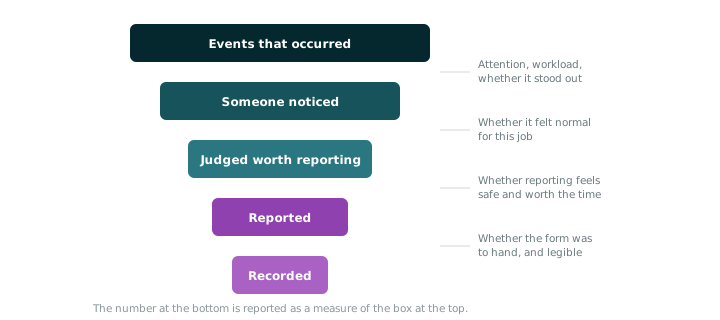
Each narrowing has its own causes, and they are different causes. A campaign aimed at the bottom of the funnel will not move the top of it.
Why the middle of the funnel is the hard part
Two filters do most of the work, and neither is about diligence.
Whether it felt normal. A forklift and a pedestrian pass closer than they should. If that has happened twice a day for two years, it does not register as an event. It registers as Tuesday. Diane Vaughan named this the normalisation of deviance: the deviation becomes the standard, quietly, without anyone deciding.
You cannot report something you have stopped seeing. This is the part that training genuinely does help with — and also the part where training wears off fastest.
Whether reporting feels safe and worth the time. Here is the one that gets misread most often.
James Reason argued that a reporting culture is the engine of a safety culture, and that it depends on a just culture — a shared, trusted understanding of where the line between acceptable and unacceptable behaviour sits. Sidney Dekker developed the point: what matters is less the written policy than whether people believe, from what they have seen happen to others, that an honest account will be treated fairly.
That belief is formed by precedent, not by policy. One investigation that ended in discipline teaches the whole site more than a year of encouragement.
People are not weighing up whether to do the right thing. They are predicting what will happen to them, usually accurately.
Why incentives usually backfire
The intuitive fix for a low number is to reward a higher one. Prizes for reporting, targets for observations, league tables by department.
It is a well-documented trap, and the mechanism is simple. An incentive attached to a count produces counts. It produces trivial reports that are safe to file, and it leaves the serious ones exactly where they were — because the thing suppressing those was never a lack of motivation.
The mirror image is worse. Where a low incident count is rewarded — bonuses tied to days without a recordable, site league tables on lost-time rates — the incentive lands squarely on not recording. Nobody has to decide to conceal anything. The pressure does the work.
Goodhart's observation applies cleanly here: a measure that becomes a target stops being a good measure.
So what should a reporting rate be read as?
Not as a safety outcome. As an instrument reading, with known biases.
A rising rate is usually good news. It is nearly always the first sign that people have decided reporting is worth doing. It is also the moment it looks worst on a board slide, which is why a great deal of organisational effort goes into explaining it away.
A falling rate is ambiguous and should never be presented as improvement. It is consistent with genuine improvement, with a drop in trust, and with people being busier than they were.
A flat rate across very different areas is a warning. If a high-risk area reports at the same rate as a quiet one, the number is being produced by something other than events.
What actually helps
Separate the report from the investigation. Much reluctance is not about the report. It is about what the report starts — the questions, the time, the possibility of blame. Making the first step small and the consequences predictable addresses the real objection.
Close the loop visibly. The strongest predictor of whether someone reports again is whether anything happened last time. This is unglamorous and it works better than any campaign.
Apply the substitution test, publicly. Dekker's version: would another person, with the same training, under the same pressures, in the same circumstances, plausibly have done the same? If yes, the finding is about conditions, not the individual. Doing this consistently is how a just culture becomes believable rather than stated.
Measure some things that do not depend on anyone choosing to report. This is the honest limit of the whole approach. Every filter in that funnel sits upstream of the number, and no amount of good culture removes them entirely — people are busy, attention is finite, and the events that have become normal are invisible by definition.
Any observation that does not require someone to stop, decide and submit skips the filters altogether. It will not tell you what people were thinking, which is exactly what a good report does. But it does not get quieter when the site gets busier, and it does not need anyone to feel safe first.
The reframe
If near-miss reporting is low, the useful question is not how do we get people to report more?
It is: what is this number telling us about the conditions that produced it? Low trust, high workload, a hazard that has become background, a form that takes four minutes on a shift with no spare four minutes. Each of those has a different fix, and only one of them is a communications problem.
Treat the reporting rate as a thermometer, a lagging indicator of conditions. It is a genuinely useful instrument. It is just not measuring what the agenda item usually says it is.
Common questions
Why are near-miss reporting rates so low?
Several filters sit between an event and a written record: whether anyone noticed, whether it registered as unusual rather than normal, whether reporting felt safe and worth the time, and whether a form was actually to hand. Most of these have nothing to do with how much people care.
Do incentive schemes increase near-miss reporting?
They increase counts, usually by producing trivial reports that are safe to file. They rarely surface the serious ones, because motivation was not what was suppressing those. Incentives tied to a low incident count are worse, because the pressure lands on not recording.
Is a rising near-miss reporting rate a bad sign?
Usually the opposite. A rise is most often the first sign that people have decided reporting is worth doing. A falling rate is the ambiguous one — it is equally consistent with improvement, with a loss of trust, and with people simply being busier.
What is a just culture?
A shared and trusted understanding of where the line between acceptable and unacceptable behaviour lies, so that honest reporting is not punished. Reason described it as the foundation of a reporting culture; Dekker's work emphasises that it is established by precedent and visible consistency rather than by written policy.
What is the substitution test?
A test associated with Dekker's work on just culture: would another person, with similar training and experience, under the same pressures and in the same circumstances, plausibly have acted the same way? If so, the finding points at conditions rather than at the individual.
References
- Reason, J. (1997) Managing the Risks of Organizational Accidents — reporting culture, just culture
- Dekker, S. (2016) Just Culture: Restoring Trust and Accountability in Your Organization
- Dekker, S. (2014) The Field Guide to Understanding 'Human Error'
- Vaughan, D. (1996) The Challenger Launch Decision — normalisation of deviance
- Hollnagel, E. (2014) Safety-I and Safety-II: The Past and Future of Safety Management
- Health and Safety Executive, Managing for health and safety (HSG65) — active and reactive monitoring
- Health and Safety Executive — RIDDOR reporting requirements
- Goodhart, C. (1975), as popularised by Strathern, M. (1997) — "when a measure becomes a target, it ceases to be a good measure"
Published 18 November 2026 · Last updated 18 November 2026
This piece starts from the ideas set out in How We Think About Safety.
Wondering what a camera would see at your gate? Request a Safety Mapping — one camera, two weeks, at no cost.